
Locus Elite Fake News Detection Methodology : Content Credibility Analysis

Locus Elite identifies disinformation using a multi-layered source verification and narrative validation framework designed for real-time crisis monitoring.
The methodology evaluates information origin, source credibility, propagation patterns, and official confirmation signals to determine the reliability of emerging claims.

1. Source Origin Verification 📰
The system continuously monitors over 100,000 media outlets and institutional accounts, with more than 10,000 verified credible sources whitelisted (major news agencies, government accounts, and established journalists).
When a claim appears, the platform first evaluates:
- Whether the claim originated from a verified media outlet
- Whether it was published by unverified social accounts
- Whether it can be traced to a primary source
Claims without traceable origin are immediately classified as low credibility signals ⚠️.
2. Information Traceability (WH Verification) 🧭
Locus Elite performs rapid information traceability analysis, answering key verification questions:
- Who reported the information first?
- Where was it published?
- When did the claim emerge?
- What source or authority is cited?
If these questions cannot be clearly answered, the information is treated as unverified or potentially misleading ❗.
3. Cross-Media Confirmation Analysis🌐
The system checks whether the same claim appears across multiple independent media outlets.
Reliable information typically follows a multi-source confirmation pattern, while disinformation often appears as:
- A single-source claim
- Social media amplification without credible reporting
This signal helps distinguish verified reporting from unconfirmed narratives.
4. Propagation Pattern Analysis 📡
Locus Elite analyzes how the information spreads through the media ecosystem.
Credible information typically propagates through:
News Agency → Media Outlets → Journalists → Public
Disinformation often follows a different path:
Unknown Source → Social Accounts → Coordinated Amplification → Viral Spread
Propagation patterns therefore provide a strong indicator of information authenticity.

5. Official Confirmation Monitoring 🏛️
The platform continuously monitors government and institutional channels for confirmation or denial signals.
If an official entity confirms or rejects a claim, the credibility assessment is immediately updated.
6. Credibility Risk Scoring 📊
Each claim is assigned a credibility risk score from 1–10 based on the combined signals above.
1-3 : Verified information supported by credible sources ✅
4–6: Developing or unconfirmed information ⚠️
7–10: High likelihood of disinformation or fabricated claims 🚨
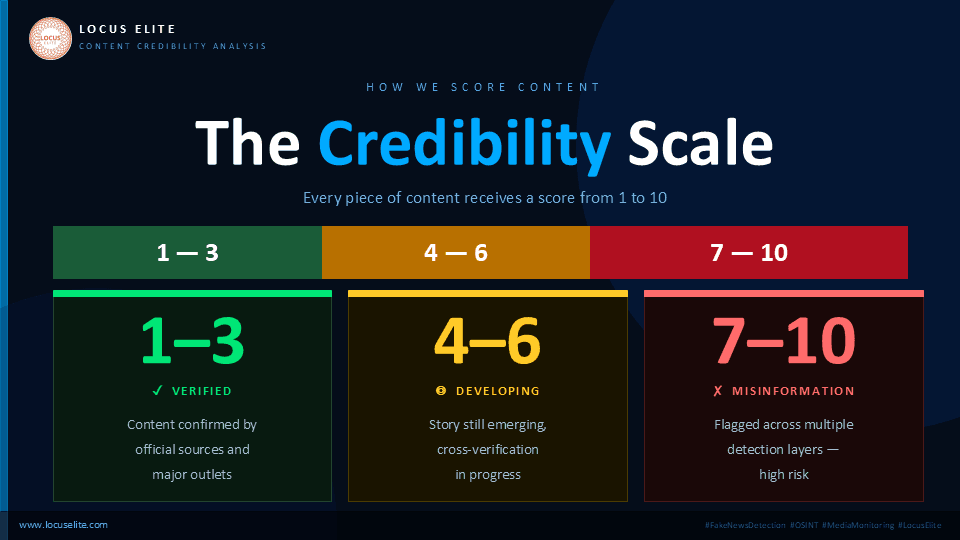
This scoring system allows analysts and decision-makers to prioritize verification efforts and rapidly identify potential disinformation during crisis situations.